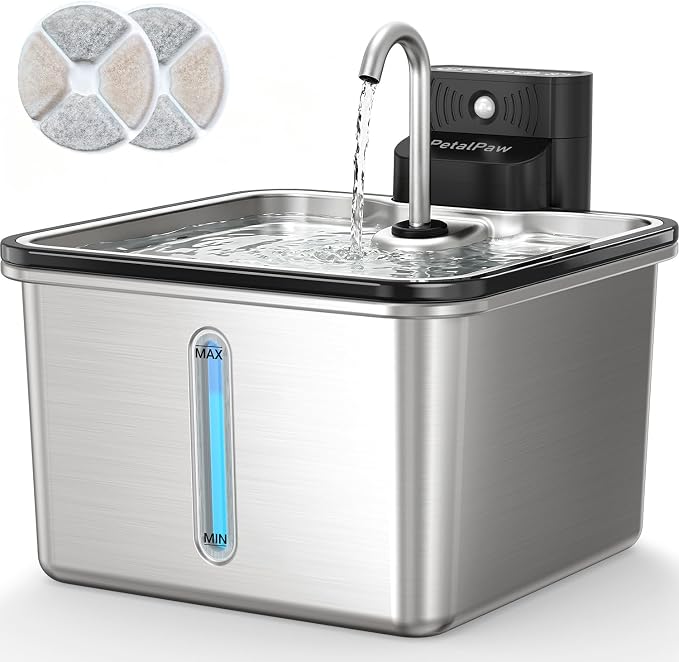
No cable to trip over, and the battery charges separately from the water. It suits a room without a socket and cats that chew cords.
Pros: cordless; battery detaches for charging; stainless and dishwasher-safe; quiet.
Cons: needs recharging; a cord is still used for constant-flow mode.
Best for: rooms without a socket and safety-conscious homes.
Cleaning routine
A fountain is only as good as its cleaning routine. Warm, unfiltered water grows slime quickly.
| When | What to do |
|---|
| Daily | Rinse the bowl and top up with fresh water |
| Weekly | Take it apart, wash the bowl and pump parts, and refill |
| Every 2 to 4 weeks | Replace the filter |
| Monthly | Descale the pump if the water is hard, and check the impeller |
If you cannot keep up with a weekly clean, a simple bowl you rinse twice a day is the better choice.
Signs your cat may not be drinking enough
A fountain is not a diagnosis. If you notice these signs, speak to your vet:
- Very little urine in the litter box, or none at all.
- Dry or tacky gums, or skin that stays tented when gently pinched.
- Lethargy, hiding or loss of appetite.
- Straining in the litter box, or crying while urinating.
- Constipation or weight loss.
Increased thirst can also be a warning sign, not a success. If your cat suddenly drinks much more, ask your vet.
How to introduce one
- Put the fountain where the cat already drinks.
- Let it run for a day before expecting interest.
- Keep a bowl nearby at first, so the cat is not forced to switch.
- Clean it weekly — a fresh fountain is far more appealing.
- Give it a week before deciding.
When to see a vet
If your cat drinks very little, or suddenly more or less than usual, or shows signs of dehydration, that is a vet conversation — not a product choice. See how to get a cat to drink more water.
FAQ
Do cats need a water fountain?
No — a clean bowl is enough for many cats. But many cats drink more from moving water, so a fountain can help if your cat drinks little.
Are water fountains better than bowls?
For some cats, yes, because the moving water encourages drinking. For others, a wide bowl is fine. It depends on the cat.
Can a fountain make my cat drink more?
Often, yes. Owners frequently report more drinking after switching. Keep it clean and quiet for the best chance.
Are plastic fountains bad for cats?
Plastic can scratch and hold slime and smells. Stainless steel or glass stays cleaner and is easier to keep hygienic.
How often should I clean a fountain?
Rinse daily, wash the parts weekly, and change the filter every 2–4 weeks. Our cleaning guide has the full routine.
Can a dirty fountain make my cat sick?
Yes. Slime and bacteria build up quickly, especially in plastic. A fountain that is hard to clean, or rarely cleaned, is worse than a bowl. Choose one you can strip down easily.
How much electricity does a cat fountain use?
Very little. Most pumps run continuously at a few watts, similar to a small appliance on standby. A cordless model avoids the cable and uses a rechargeable battery.
What is the best fountain for an older cat?
A quiet, low fountain with a shallow drinking area and a low entry. Avoid tall designs and ones with a high lip the cat has to reach over.
Is a fountain good for multiple cats?
It can be, but provide more than one water source and clean them often. Some cats will not share a fountain, and a large reservoir does not replace fresh water.
The bottom line
Cats do not need a fountain, but many drink more from one — and that is worth it for an older cat or a cat that ignores its bowl. Choose a quiet, easy-to-clean stainless or glass model, keep it clean, and give it a week. If your cat is unwell or its drinking changes suddenly, see your vet. For the products, see best cat water fountain; for a cat that avoids water, read cat not drinking water.