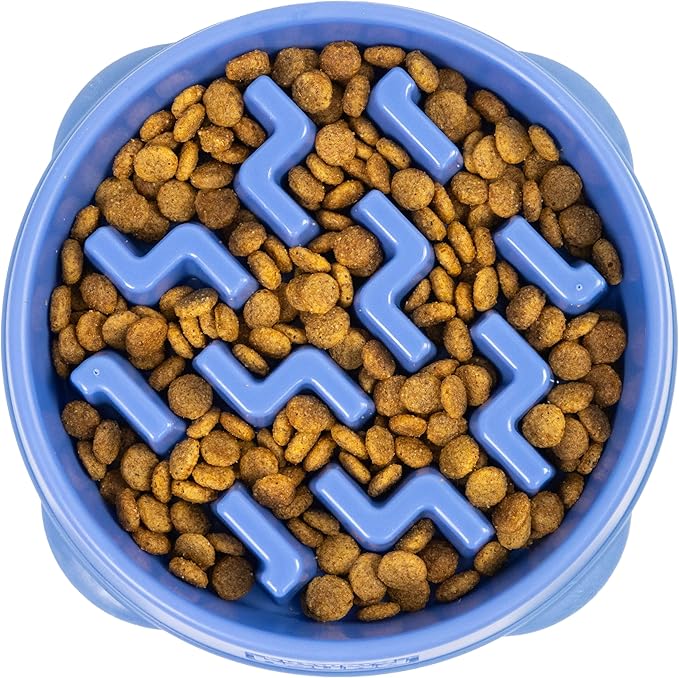
This is the slow feeder we would buy. A maze of ridges and grooves forces the dog to work around the bowl, slowing eating by up to 10x. It is non-slip, food-safe (no BPA, PVC, lead or phthalates) and top-rack dishwasher-safe. It has a 4.6-star rating over 135,000 reviews.
Pros: slows eating dramatically; non-slip base; food-safe materials; dishwasher-safe; several sizes and difficulty levels; excellent price.
Cons: some dogs need the easiest level first; deep grooves need a rinse before the dishwasher; check the size for a large dog.
Best for: fast eaters and dogs that vomit or gulp after meals.
What owners say: The consistent result is that it works — a 30-second meal becomes about 10 minutes, including for a boxer. Owners say it reduces begging and gives the dog a job. A few dogs take a little time to work out the maze.
Best treat puzzle: Potaroma Two-Level Puzzle
For mental work as well as slower eating, this puzzle turns a meal into a two-level game: the dog nudges and presses to release food. It also works as a slow feeder and a boredom-buster, with a non-slip weighted base. It scores 4.4 stars over 4,000 reviews.
Pros: two difficulty levels; slows eating and tires the mind; doubles as a slow feeder; non-slip base; no small parts; no assembly.
Cons: clever dogs may finish quickly; slides a little on some floors; best for food-motivated dogs.
Best for: clever, high-energy dogs and treat-time enrichment.
What owners say: Owners of working breeds say it works the dog's brain and slows fast eaters, and some use it for daily meals. A puppy owner notes level one is easy and level two takes more working out.
Slow feeder types compared
Slow feeders are not all the same shape. The right one depends on what your dog eats and how quickly it gives up.
| Type | How it works | Best for | Cleaning |
|---|
| Maze bowl | Ridges and grooves force the dog to nudge food out | Most fast eaters, dry kibble | Rinse the grooves after each meal; top-rack dishwasher if labelled safe |
| Puzzle feeder | Sliding or lifting parts hide the food | Clever, high-energy dogs that need mental work | More parts to wash; check each piece is dishwasher-safe |
| Lick mat | A textured mat holds wet food for licking | Wet food, anxious dogs, treat time | Soak in warm water, then wash by hand or in the dishwasher |
| Snuffle mat | Fabric strips hide kibble for nose work | Boredom, gentle eating, scent games | Shake out crumbs; some are machine washable |
A maze bowl is the simplest starting point for a dog that bolts dry food. A puzzle is better for a dog that is bored as well as fast. A lick mat suits wet food, but it slows licking rather than chewing, so it is a different kind of meal.
Sizing: match the feeder to your dog
- Small dogs and puppies: choose a shallow maze with low ridges. A deep bowl can be hard to reach and the dog may give up.
- Medium dogs: a standard maze bowl is usually right. Check that the food spread fits the bowl without overflowing.
- Large and giant dogs: look for a wide bowl with a heavy, non-slip base. A big muzzle needs room to reach the grooves, and a light bowl will be pushed across the floor.
- Flat-faced breeds: a shallow maze or a flat lick mat is easier to reach than a deep bowl.
- Older dogs: choose smooth, rounded grooves and a bowl you can rinse without a brush. Keep the bowl on a stable surface so the dog does not have to chase it.
How to introduce a slow feeder
Do not simply swap the old bowl for a hard maze at the next meal. A hungry dog that cannot get the food may give up, gulp from a second bowl, or knock the feeder over.
- Start easy. Use the shallowest setting, or scatter a little kibble loosely on top of the maze.
- Mix familiar and new. Put most of the meal in the slow feeder and a small amount in the old bowl for the first meal or two.
- Stay close. Watch the first three or four meals. Praise the dog when it works the food out.
- Build difficulty. Once the dog finishes in a calm five to ten minutes, move to a harder maze or add a puzzle.
- Keep the meal size the same. A slow feeder changes the speed, not the amount. Weigh or measure the food as usual.
- Keep water available. Some dogs drink straight after eating; a slow feeder can make that less frantic.
- Rinse after every meal. Dried food in deep grooves is harder to remove later.
If the dog refuses or gets frustrated
- Put a few pieces of food in the shallowest grooves first.
- Try the feeder at a quiet time, not when the dog is frantic with hunger.
- Warm wet food smells stronger and is easier to lick out of a shallow maze.
- If the dog still walks away after two meals, switch to a shallower bowl or a lick mat, then try again in a week.
- Never leave a frustrated dog alone with a puzzle that has small removable parts.
Wet food, raw food and treats
A deep maze bowl is designed for dry kibble. Wet and raw food pack into the corners, which makes cleaning harder and can leave old food behind.
- Use a shallow maze, a lick mat or a puzzle with removable parts for wet food.
- Spread wet food thinly on a lick mat and freeze it for a longer, calmer treat.
- Rinse wet-food feeders immediately after the meal.
- Do not leave raw food sitting in a bowl at room temperature.
Cleaning and everyday use
- Rinse straight after the meal. A quick rinse stops food drying into the grooves.
- Check the dishwasher label. Many maze bowls are top-rack safe; some puzzle parts are not.
- Use a soft brush for deep grooves. That is the one fiddly part of a maze bowl.
- Dry fully before refilling, especially with wet food.
- Keep a spare. If the bowl is in the dishwasher, a second one avoids a return to the fast bowl.
When to see a vet
A slow feeder helps with speed, not with disease. Contact your vet promptly if your dog:
- Retches without bringing anything up, drools heavily or has a swollen, hard belly. These can be signs of bloat, which is an emergency.
- Vomits repeatedly after meals.
- Loses weight even though it eats well.
- Seems painful or restless after eating.
- Suddenly starts eating much faster, or stops eating altogether.
Buying guide
- Difficulty level. "Slow", "slower" and "slowest" exist — start easy.
- Size. Match the bowl to your dog's meal and muzzle; too deep can frustrate.
- Non-slip base. A bowl that slides gets pushed around the floor.
- Food-safe material and dishwasher-safe cleaning.
- Easy-clean grooves — deep mazes need rinsing.
- No small loose parts if your dog chews or if children are around.
- A shape you can lift easily. A wide rim and a light bowl are easier on older hands.
What to avoid
- A very hard maze for a first-time dog (it can give up).
- Using a slow feeder with wet food in deep grooves (hard to clean).
- Relying on it instead of a vet visit for frequent bloating or vomiting.
- Bowls that slide or tip.
FAQ
Do slow feeders really work?
Yes — they can slow eating by up to 10x by making the dog work around ridges and grooves. Most fast eaters adapt within a few meals.
What is the best slow feeder for a large dog?
A large-size maze bowl like the Outward Hound, or the Potaroma puzzle if you want mental work too. Check the size for a big muzzle.
Are slow feeders good for bloat?
They help by slowing eating and reducing swallowed air, but bloat is complex. If you have a deep-chested breed, ask your vet about prevention as well.
Can I use a slow feeder for wet food?
You can, but deep grooves are harder to clean. A shallower maze or a puzzle with removable parts works better.
How do I clean a slow feeder?
Rinse the grooves after each meal, and put it in the top rack of the dishwasher regularly (check it is dishwasher-safe).
How long should a meal take with a slow feeder?
Aim for five to ten minutes. If the dog finishes in two minutes, use a harder maze or add a puzzle. If the dog gives up, go back to an easier shape.
What is the best slow feeder for a flat-faced dog?
A shallow maze or a flat lick mat. Deep grooves are hard for a short muzzle to reach, and the dog may become frustrated.
Can puppies use a slow feeder?
Yes, with a shallow bowl and supervision. Puppies are still learning to eat, so start easy and keep meal times calm.
Why does my dog flip the bowl over?
Usually the bowl is too light, too hard, or the dog is hungry and frantic. Choose a heavy non-slip base, start on the easiest setting, and feed at a regular time.
Do slow feeders help with bloat?
They slow eating and reduce swallowed air, which is helpful, but bloat is complex. If you have a deep-chested breed, ask your vet about prevention as well.
Can I use a slow feeder for wet food?
You can, but deep grooves trap wet food. A shallow maze or a lick mat is easier to clean and kinder to the dog's nose.
The bottom line
For a dog that eats too fast, a slow feeder is a cheap, effective fix. The Outward Hound maze bowl is the most proven choice, and the Potaroma puzzle adds mental work for a clever dog. Start on the easiest setting, keep the meal size the same, rinse the grooves after every meal, and watch the first few meals.
Two simple rules matter most. If the dog gets frustrated, make it easier. If the dog still bolts, make it harder. And if there is repeated bloating, vomiting or pain, treat that as a vet question — a bowl cannot fix a medical problem.