How Much Should You Feed a Dog? (Simple Guide) | Animal How To
How Much Should You Feed a Dog? A Simple Guide
·
Some links on this page are affiliate links. If you buy through them, we may earn a commission at no extra cost to you. Read our affiliate disclosure.
"How much should I feed my dog?" is one of the most common questions, and the honest answer is: it depends on the dog. Needs vary with weight, age, activity, neutering and the food itself. But there are simple rules of thumb to start from — and one reliable way to check you have it right: your dog's body condition.
Quick answer
Start with the food label and the calories per cup or can.
Measure the food instead of guessing or free-pouring.
Feed two measured meals a day for most adult dogs.
Check body condition: ribs easy to feel, a visible waist.
Keep treats under 10% of daily calories.
Adjust gradually and weigh the dog now and then.
Start with the food label
The label is the best starting point, because foods vary hugely in calories. Look for the calories per cup or per can (the "kcal" figure), not just the feeding table.
The label gives a range for your dog's weight.
Start at the low end for the stated weight.
Weigh or measure the food rather than guessing.
Then adjust up or down based on your dog's body condition (below).
A rough guide
As a very general guide for a healthy adult dog:
Around 20 to 30 calories per pound of body weight per day, plus the base metabolic need — many medium dogs sit around 700 to 1,000 calories a day.
High-energy or working dogs need more; couch potatoes and senior dogs need less.
Wet food is mostly water, so a can has far fewer calories than its weight suggests — always check.
Treats should be no more than about 10% of daily calories.
How to tell if you have it right
The best measure is the dog, not the label. Feel your dog's body:
Ribs: easy to feel under a thin fat layer, but not sharply visible.
Waist: a visible tuck behind the ribs, seen from above.
Tummy: runs up from the chest to the hind legs, not sagging.
If your dog looks and feels right and holds a steady weight, your portions are good. If the ribs are hard to feel, cut back a little; if they are prominent, feed a little more.
A bowl that helps you measure and eat comfortably
Serving a measured amount is easier — and kinder to your dog's neck, especially for a large dog — with an adjustable elevated stand:
Best Overall
Elevated Dog Bowls for Large Dogs 5 Adjustable Heights 7.5"-15.4", 2 X-Large 10” Stainless Steel Bowls, Heavy Duty Raised Dog Bowl Stand Foldable Pet Feeder for Dogs Shoulder Height Over 15”, Black
COMESOON · 4.60 (12,437) ★
A measured, elevated bowl makes correct portions easy to serve and comfortable for your dog to eat.
Scheduled meals (one or two a day for adults) let you measure portions, watch appetite and catch changes early.
Free-feeding dry food makes it easy to overfeed and hides appetite changes; if you free-feed, measure the daily amount.
Multi-dog homes need care: a greedy dog may eat another's food, so feed separately or supervise.
Portion guide at a glance
This is a starting point only. Always check the calories on your own food, because brands vary widely.
Dog weight
Typical adult range
Meals a day
Under 10 lb
About 200 to 400 calories
2
10 to 25 lb
About 350 to 700 calories
2
25 to 50 lb
About 600 to 1,100 calories
2
50 to 80 lb
About 900 to 1,600 calories
2
Over 80 lb
About 1,300 to 2,200 calories
2
High-energy and working dogs sit at the top of the range; senior, neutered and inactive dogs at the bottom. Wet food contains a lot of water, so check the can's calorie figure rather than its weight.
How to adjust safely
Change by small amounts. Adjust by about 10% at a time and wait a week or two.
Weigh the dog every few weeks on the same scale.
Watch body condition, not just the scale. A steady weight with good shape is the goal.
Count treats and chews in the daily total.
Do not crash-diet a dog without vet advice; sudden restriction can be harmful.
Measuring tools
A kitchen scale is the most accurate way to weigh kibble.
A measuring cup is fine if you level it off each time.
Keep the scoop with the food so everyone uses the same one.
If several people feed the dog, write the portions down or use a shared note.
Feeding puppies and older dogs
Puppies need more, in more frequent small meals, with food suited to growth.
Older dogs often need fewer calories but more digestible, quality protein. Weight loss or gain without a diet change is a vet visit — it can signal thyroid, kidney or dental problems.
When to see a vet
Sudden weight loss or gain with no change in diet.
Your dog stops eating, or eats ravenously and still loses weight.
Vomiting or diarrhoea after meals.
You cannot feel the ribs, or they are sharply visible.
FAQ
How many times a day should I feed my dog?
Most adult dogs do well on two measured meals a day. Puppies need more frequent small meals; some older dogs prefer two smaller portions.
How do I know if I am feeding my dog enough?
Check body condition — you should feel the ribs easily but not see them, and see a waist. Steady weight on the same diet is the clearest sign.
Is it OK to leave dry food out all day?
You can, but measure the daily amount and do not keep topping up, or your dog will overeat. Scheduled meals make portion control easier.
How many treats can I give?
Keep treats to about 10% of daily calories or less, and count them as part of the day's food. Too many treats is a common cause of weight gain.
My dog always seems hungry — am I underfeeding?
Not necessarily — some dogs beg out of habit. Check body condition and weight; if your dog is genuinely losing weight or eating far more than expected, see your vet.
Should I feed my dog before or after a walk?
Feed after a walk, or wait about an hour after a large meal before vigorous exercise. This is especially important for deep-chested breeds at risk of bloat.
How do I measure kibble without scales?
Use a measuring cup and level it off each time. Keep the same cup, and check the bag's calorie figure so you know what a cup provides.
Can I feed my dog once a day?
Some adult dogs do fine on one meal, but two meals are gentler on digestion and make it easier to spot appetite changes. Puppies and many senior dogs need more frequent meals.
The bottom line
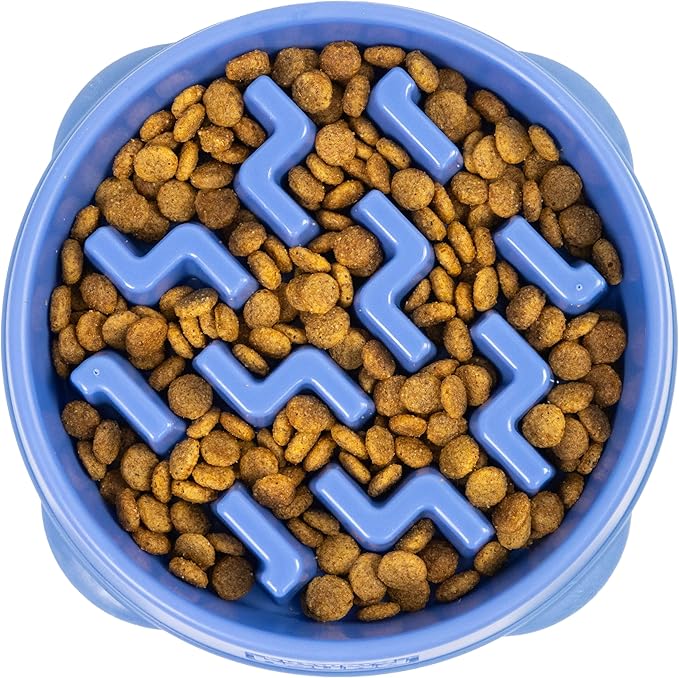
Start from the calories on the food label, feed a measured amount in one or two meals, and let your dog's body condition be the guide. A measured, elevated bowl makes portioning easy, and a slow feeder helps a greedy dog. If weight or appetite changes without reason, that is a vet visit. For gear, see best dog bowl and are elevated dog bowls better.
Comparison
Product comparison
Product
Best for
Price
Rating
Link
Elevated Dog Bowls for Large Dogs 5 Adjustable Heights 7.5"-15.4", 2 X-Large 10” Stainless Steel Bowls, Heavy Duty Raised Dog Bowl Stand Foldable Pet Feeder for Dogs Shoulder Height Over 15”, BlackCOMESOON
We may earn a commission when you buy through links on this page.
Frequently asked questions
How many times a day should I feed my dog?
Most adult dogs do well on two measured meals a day. Puppies need more frequent small meals; some older dogs prefer two smaller portions.
How do I know if I am feeding my dog enough?
Check body condition — you should feel the ribs easily but not see them, and see a waist. Steady weight on the same diet is the clearest sign.
Is it OK to leave dry food out all day?
You can, but measure the daily amount and do not keep topping up, or your dog will overeat. Scheduled meals make portion control easier.
How many treats can I give?
Keep treats to about 10% of daily calories or less, and count them as part of the day's food. Too many treats is a common cause of weight gain.
My dog always seems hungry — am I underfeeding?
Not necessarily — some dogs beg out of habit. Check body condition and weight; if your dog is genuinely losing weight or eating far more than expected, see your vet.