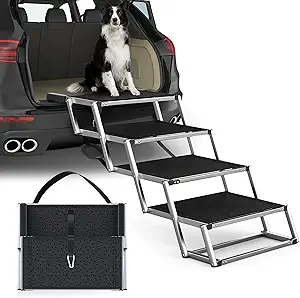
Safety tips
- Always use the ramp or steps both ways — jumping down is harder on joints than jumping up.
- Use a harness and a lead so you keep control and can steady the dog if it wobbles.
- Non-slip grip matters. If the surface is slick, add a carpet strip or non-slip mat.
- Check the weight limit of your ramp or steps against your dog's weight.
- Do not rush or force. A bad experience sets training back; keep it calm and rewarding.
- Ask your vet if your dog seems in pain, is very unstable, or has had surgery — they may advise a sling or harness-assisted lift.
Ramp, steps or sling?
| Option | Best for | What to watch |
|---|
| Long ramp | Stiff hips, limited mobility, tall vehicles | Needs floor space; must be non-slip and secured |
| Wide steps | Dogs that can still step but should not jump | Not ideal for very unstable dogs |
| Support sling | Very weak hind legs, after surgery | Ask your vet or physio for the right type |
| Two-person lift | Only when there is no alternative | Injury risk to you and the dog |
Car safety after loading
- Secure the dog with a crash-tested harness or a crate. A loose dog can be injured or distract you.
- Do not let the dog jump out at the destination; use the ramp or steps again.
- Keep the car cool and never leave the dog unattended.
- Take water for longer trips and plan breaks.
- Check the ramp or steps are packed so you can unload safely at the other end.
A note on harnesses and slings
If your dog needs extra help, a support harness or sling (for the hind end) can lift the legwork without straining either of you. Ask your vet or a physio which suits your dog, especially after surgery or with a diagnosed condition.
FAQ
How do I get my old dog into the car without lifting?
Use a long, non-slip ramp at a gentle angle, or wide steps, and train gently with treats. Let the dog move on its own four legs, and reward every step.
Are ramps or steps better for a senior dog?
For a dog with limited mobility, a ramp is easier. For a dog that can still step but should not jump, wide steps work well. Let your dog choose when possible.
What if my dog is too heavy to lift?
That is exactly when a ramp or steps earn their place — they protect your back and the dog's joints. Choose one rated well above your dog's weight.
My dog is scared of the ramp — what do I do?
Go slowly, put it low, lure with treats, and never force it. Our guide to why a dog will not use its ramp covers training in detail.
Should I help the dog down as well as up?
Yes. Getting down is often harder on joints and is a common time for slips — keep using the ramp or steps both ways.
How do I stop my dog jumping out of the car?
Keep the lead on, open the door, and guide the dog to the ramp or steps. Do not let it leap out, especially onto hard ground. Reward it for waiting.
Is it safe to lift my dog under the belly?
Only with care. A support harness or sling spreads the weight and is safer than lifting under the belly. Ask your vet or physio which method suits your dog.
What if my dog refuses to get in the car?
Go back to a low ramp and reward one paw at a time. Do not force or push. If the refusal is new, check whether pain or fear is the reason.
The bottom line
Helping an older dog into the car is about letting it move on its own legs, at its own pace, with grip and a gentle slope. A long, non-slip ramp is the kindest way up; wide steps suit a dog that prefers to step. Train slowly with treats, secure the ramp, and use it both ways — and you can keep taking your dog out without the strain or the worry. For more, see best dog ramp and why won't my dog use its ramp.